
Sources checked 23 November 2026.
A vehicle is still on the lift. The person who inspected it has gone home. The customer wants to know whether it will be ready tomorrow. Someone has ordered a part, but the delivery estimate is buried in a message.
That is a handover problem before it is a software problem. The next person needs a reliable account of what is known, what has been agreed and what happens next. A long note saying “waiting” rarely supplies that account.
This workshop handover checklist works on paper, in a shared document or in a connected job record. It applies to an independent repair shop in any market; local invoicing, inspection and record-keeping requirements still need their own checks.
1. Separate the complaint from the finding
Start with two distinct sentences. The complaint describes what the customer reported. The finding describes what the workshop has actually observed or tested.
In a worked example, “rattle over rough roads” is the complaint. “Noise reproduced on the agreed test route; further inspection required” is a finding. “Replace suspension” is neither a clear observation nor a sufficiently specific agreed repair.
Keep the useful evidence with that finding. A photograph may identify the location being discussed; a test result may explain why another check is needed. Record uncertainty plainly. The next person should not have to infer that a suspected cause has become a confirmed diagnosis.
Include the vehicle or job reference and the inspection date. If more than one person has worked on the vehicle, record who made the observation. These small details make a follow-up question answerable.
2. State what the customer has approved
“Customer called” does not say whether anything was authorised. Record the scope presented, the version or date of the proposal, the customer’s actual decision and any spending limit or exclusions.
A useful example handover might read: “Customer approved the inspection only. Replacement work has not been approved. Send the revised estimate after inspection.” The wording prevents a later reader from treating permission to investigate as permission to repair.
If the proposed work changes, keep the new decision linked to the change. Avoid silently editing an old proposal so it looks as though the customer accepted a different scope. Your process should make it possible to explain the sequence without searching personal messages.
This is a record-design suggestion, not a guarantee that a particular communication meets every market’s legal requirements. Follow the rules and advice applicable to your business.
3. Give parts a status and a chase time
A part is not simply “done” or “not done”. It may be identified, ordered, back-ordered, received or awaiting a fitment check. Write the state that is true now.
Add the supplier reference where useful, the expected delivery information and the next chase time. If the supplier has given no reliable date, say that. An estimated arrival should not become a promised collection time without checking the remaining work.
For example: “Correct variant still to be confirmed. Morgan to check the supplier listing at 09:30 before ordering.” That record gives a person an action. “Parts issue” gives the whole workshop another puzzle.
Keep commercially sensitive supplier information in the appropriate internal record. A customer update usually needs the consequence and next update time, rather than the workshop’s entire purchasing conversation.
4. Assign the next action to one person
The job status describes the situation. The next action describes the task. You need both.
“Awaiting approval” is a useful status. “Alex to send the revised proposal by 10:00” makes it actionable. If no individual owns that step, several people may assume someone else has dealt with it.
Choose one immediate next action rather than copying the entire repair plan into the handover. After that action happens, update the record with its outcome and the new next action. Where another person must check the work, make that checkpoint explicit.
An owner-operator can use the same method when handing a job back to their future self. A short note before leaving a vehicle can prevent tomorrow’s first task from being a reconstruction of yesterday’s decisions.
5. Record the customer promise separately
There are three different times to distinguish: the next internal task, the next customer update and the expected completion. They do not always match.
If you have promised an update by lunchtime, record that promise even when there is no confirmed completion date. “Call by 12:00 with inspection outcome; collection time not confirmed” is clearer than “tomorrow?” written beside the booking.
When circumstances change, update the promise and record the communication. Do not leave an old collection estimate visible as though it were still current. The person answering the telephone should see the same current position as the person doing the work.
A short end-of-day review
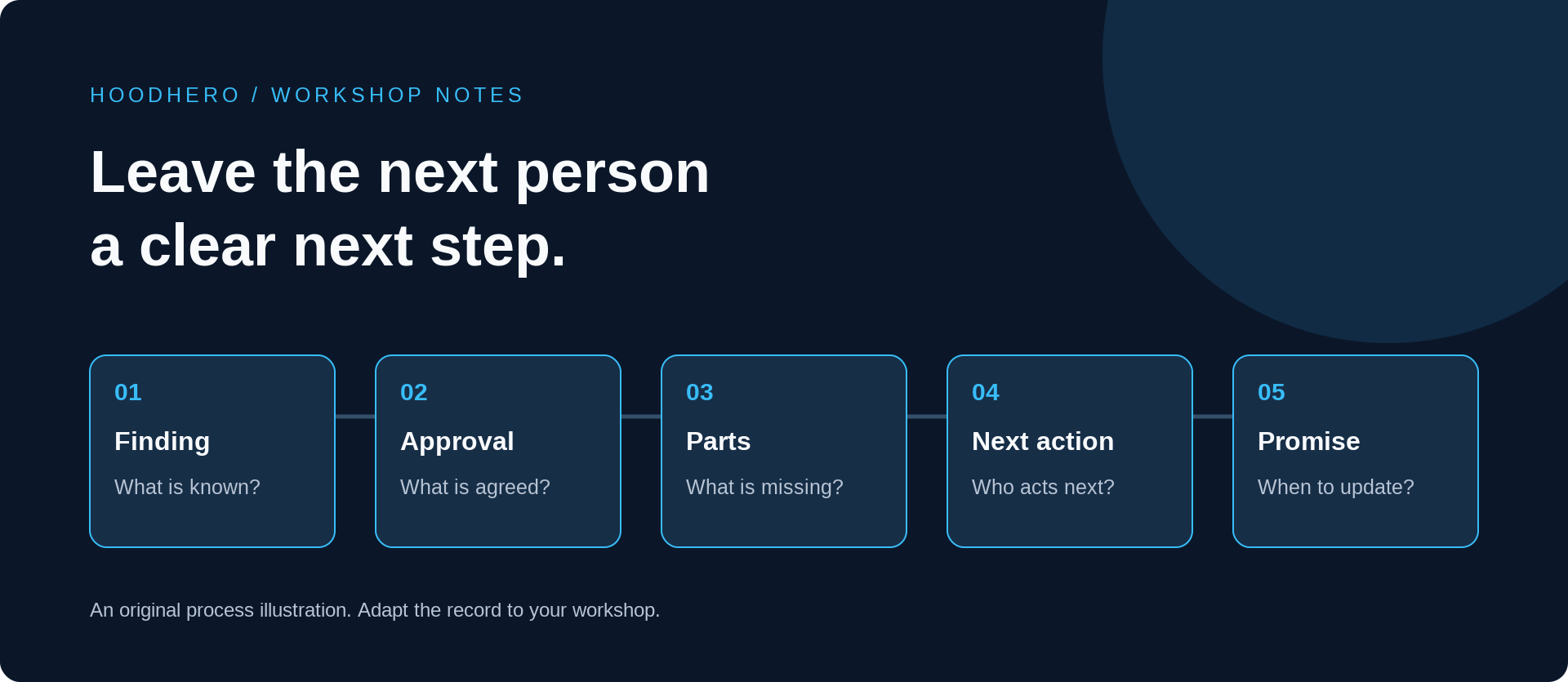
For each open job, ask five questions:
- Can someone distinguish the reported problem from the inspected finding?
- Is the approved scope clear, including work still awaiting a decision?
- Do parts have an accurate status and a next check?
- Does one person own the next action?
- Is the next customer update or collection promise visible?
Do not invent an answer to make the checklist complete. A visible gap, with someone assigned to resolve it, is more useful than a confident but inaccurate note.
When a colleague takes over, talk through the important points as well as leaving the written record. The UK’s Health and Safety Executive describes handover as preparation, exchange and cross-checking, with spoken and written communication supporting each other. In a workshop, a useful final check is to ask the incoming person to explain the next action and identify anything still uncertain. That is a communication practice, not a claim that this checklist satisfies every country’s safety rules.
Put the checklist where the work happens
The record needs to be easy to find at the moment someone takes over. If the workshop uses paper, keep the handover with the active job card. If it uses software, keep the notes, evidence and decisions connected to the same job rather than distributing them across unrelated documents.
HoodHero’s product walkthrough shows connected workshop records and job stages. Look at the actual screens, then test the checklist against one practice job. The useful question is whether the next person can understand the situation and take the right next step without needing the original technician beside them.
You do not need a complicated reporting system to start. You need five accurate facts, a place everyone can find them and a habit of updating them when the job changes.