
Sources checked November 24, 2026.
The car is ready, the front desk is busy, and an invoice arrives with several unfamiliar lines. Before you put it away, give yourself a way to understand what it records. The useful question is whether the document connects the work you approved, the work reported as completed and the amount being collected.
This US guide explains an auto repair invoice through a worked example. It is a reading checklist, not a nationwide legal template or a way to verify a repair without inspecting the vehicle. State requirements and the details of your agreement matter.
Keep the estimate, approval and invoice together
An estimate describes proposed work and anticipated charges. Your approval records the decision about that proposal. The final invoice or completed repair order describes the work being billed. A receipt or payment record shows a payment. One document may contain more than one of those things, but the meanings remain different.
Keep the version you actually approved beside the final document. If there was a later change, keep that exchange too. Comparing the final invoice with an outdated first estimate can make a legitimate revision look unexplained; losing the revision can also make an unexplained change harder to discuss.
Do not assume that an invoice marked “sent” means it has been paid. Look for the amount collected and any remaining balance separately.
Read the work description before the total
The Federal Trade Commission’s Auto Repair Basics recommends getting a completed repair order identifying the work, supplied parts and their costs, labor charges and the vehicle’s mileage readings. It also explains that labor may be priced using a flat-rate method or actual technician time.
Use those details to ask specific questions. Does the description identify the task, or only say “repair”? If your original concern was a noise, can you distinguish the inspection from any repair that followed? If a proposed item was declined, is it clearly separate from the completed work?
The paperwork helps you reconstruct the conversation. It does not prove that a suspected cause was correctly diagnosed or that every task was physically carried out.
Follow a simple worked calculation
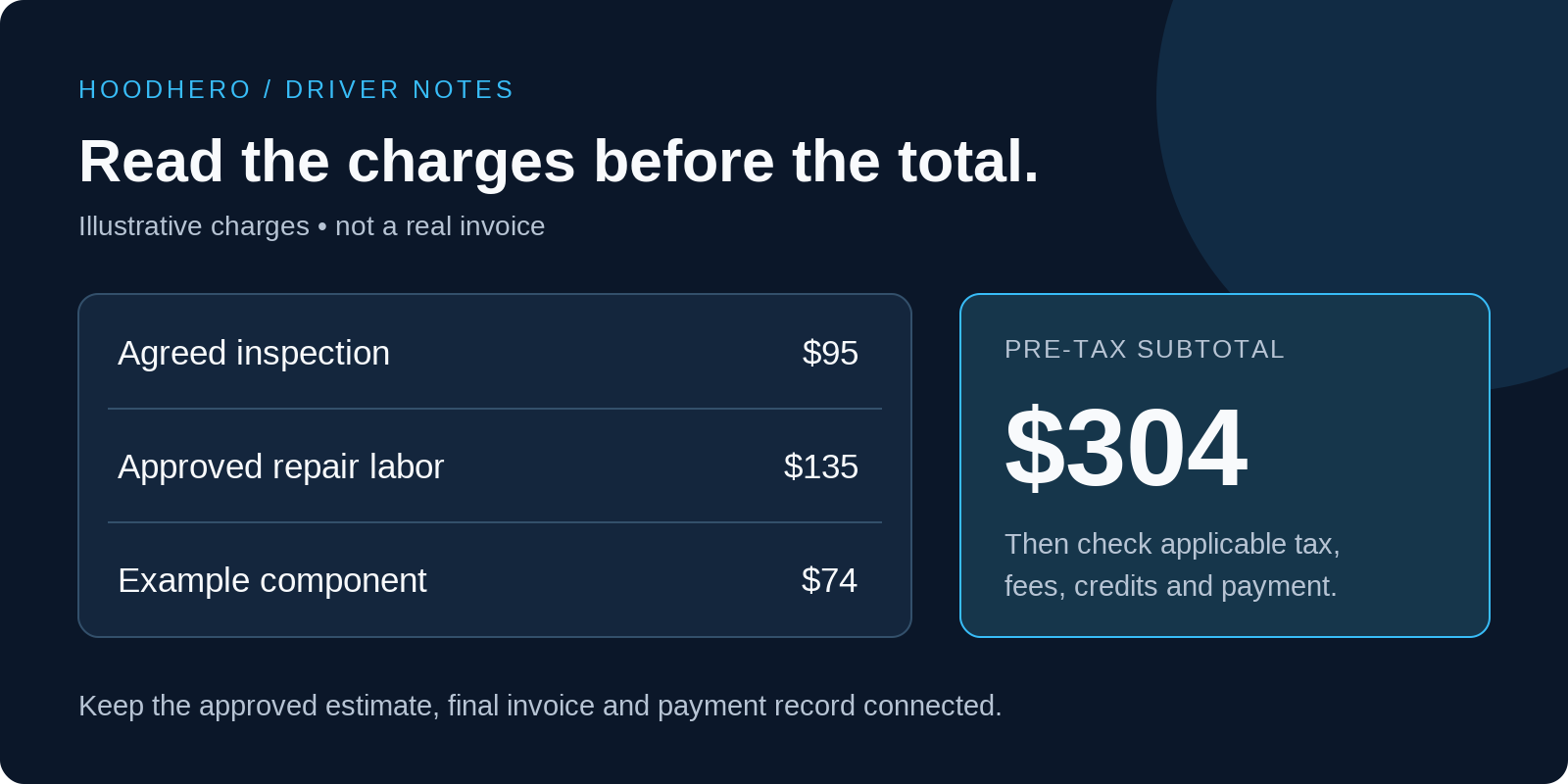
Suppose you approved an inspection, then a separate repair after the shop discussed its findings. These invented figures illustrate the arithmetic; they are not typical rates or a recommendation for a particular fault.
| Example line | Basis shown | Charge |
|---|---|---|
| Agreed inspection | One inspection | $95.00 |
| Approved repair labor | 1.5 hours at $90.00 | $135.00 |
| Replacement component | One example component | $74.00 |
| Subtotal before applicable tax | $95 + $135 + $74 | $304.00 |
On a small screen, scroll the table sideways to see every column.
The inspection and repair labor are separate lines in this example. Ask whether your own agreement treats them separately or applies any diagnostic credit. A credit should be understandable in the calculation rather than something you have to guess from the final number.
Check quantity as well as unit price. For example, two items at $37 each and one item at $74 have the same total but describe different supplies. Ask which description matches the actual job.
The $304 subtotal is not a final payable amount. Any applicable taxes, agreed fees, discounts or credits still need to be accounted for. This example deliberately does not invent a single US sales-tax rate or assume that every charge has identical tax treatment.
Ask what an unfamiliar charge represents
A line can be unclear without being wrong. Ask what the charge covers and where it fits into the work discussed. Useful questions include whether a part line covers one item or a set, whether an outside service is included, and how an agreed discount appears.
If labor hours surprise you, ask which pricing method was used instead of treating the number as a stopwatch record. If a fee was unfamiliar, ask when it was explained and how it was calculated. Keep the answer with your records.
Avoid using an online example total as proof that your bill should match it. Vehicle specification, findings, parts choice and the agreed scope can differ. Compare the explanation and the actual agreement before comparing only the final amounts.
Check the rules for your state
California illustrates why location matters. Its Bureau of Automotive Repair guidance describes estimates and authorization, approval for additional repairs, and a final invoice identifying the shop, its license number, the repairs, supplied parts and total parts and labor costs. Those are California-specific consumer protections; they are not presented here as the invoice rules for all 50 states.
For your own location, use the relevant state repair regulator or consumer-protection office. A convenient sample invoice is a useful reading aid, but it should not replace the guidance that applies where the transaction took place.
Before you leave, close the information gaps
Use this short collection checklist:
- Confirm the vehicle and visit. Check that the document refers to your car and the right appointment, especially if the shop has more than one vehicle for your household.
- Connect each charge to the agreed work. Keep later revisions with the original proposal so the sequence makes sense.
- Ask about anything still unclear. Request an explanation of unfamiliar abbreviations, quantities or credits while the record is available.
- Separate the bill from the payment. Check what was collected, what remains due and which document records the payment.
- Record the next step. Ask what follow-up, monitoring or return visit was discussed, and keep any applicable written repair-warranty information.
An item listed as a recommendation is different from a repair reported as completed. Make that distinction clear before storing the record as service history. It will make the document more useful when another shop asks what happened at this visit.
If the car has an unresolved safety concern, discuss it with a qualified technician before driving away. A paid invoice is not a safety certificate. Symptoms and fault codes are clues for investigation, not confirmed diagnoses on their own.
If the explanation still does not make sense
Ask the manager to walk through the specific lines and the approval record. Keep the documents and a dated note of the response. The FTC recommends starting with the shop’s management and using state or local consumer-protection resources when a problem remains unresolved.
A focused question is more useful than a broad accusation. “Which approval covers this extra component?” gives both sides a document to examine. Record what remains unanswered so a later conversation does not start from memory.
Keep useful repair context for the next visit
Save a readable copy with the vehicle’s other records. Give it a meaningful filename, such as the date and the job description, and keep any relevant estimate and follow-up instructions alongside it. Share only the information another shop needs; a payment-card number does not belong in a general repair note.
HoodHero’s driver apps help you organize symptoms and repair information before discussing the next step with a mechanic. AI suggestions and cost estimates need checking against the actual vehicle and a qualified assessment. They cannot establish that a billed repair happened or resolve an invoice dispute.
You can find HoodHero on the US App Store and Google Play. The main mobile features require an active paid membership; review the in-app plans, prices and renewal terms before purchasing. The Mechanic Desk web trial is a separate offer.